Ever redo a task that someone else did because you feel it was not done well enough? Maybe it’s the dishwasher, maybe it’s folding laundry, maybe it’s something for work.
And how often do you complain that others in your house don’t help? Do you spend your time with friends complaining about how you do it all around the house? How your partner just doesn’t see all that you do or even know that you do it?
You feel exhausted, overwhelmed, or tired of it all.
I wonder if by redoing a task that someone else completed, we take away their power and motivation. Thereby starting a cycle where they stop doing it and we get mad because now they’re not doing it.
I had a college roommate who would reclean the bathroom after I cleaned it because he didn’t think I did a good enough job. So I stopped cleaning the bathroom. Maybe he got mad and now he thought I was lazy, but I’m not going to do something that someone else is going to redo. It’s not worth my time and effort.
What if our partners (and maybe even our kids) feel this way? They’re tired of the nagging and having their work redone. Wondering why they even bother if it’s not good enough.
Last week I talked about how men and women have the same level of messiness. Society conditions women to care more and get to it quicker. So we expect tasks to be completed on our timeline. Not allowing others to have agency.
I wonder what would happen if we set the expectation of when something needs to be done and let our partners do it on their own time.
It can start with a conversation. With our partners. Our families. A counselor.
Remember that half the population wasn’t raised to see all the work it takes to run a household and raise kids. It’s not that they’re ignoring it, they don’t know it exists. And, as women, when we take it all on, our partners still don’t see it because we’re doing it.
These changes require patience and time. We’re not going to change these deep-seated tendencies overnight. But we can start.
Let’s start by making it more visible. Stop doing all the housework after everyone else is in bed. Stop redoing something someone else has already done. Even if you can fit more dishes in the dishwasher or think something should be folded differently, stop yourself. Try celebrating that someone else did it and now you don’t have to. That’s one thing off your plate!
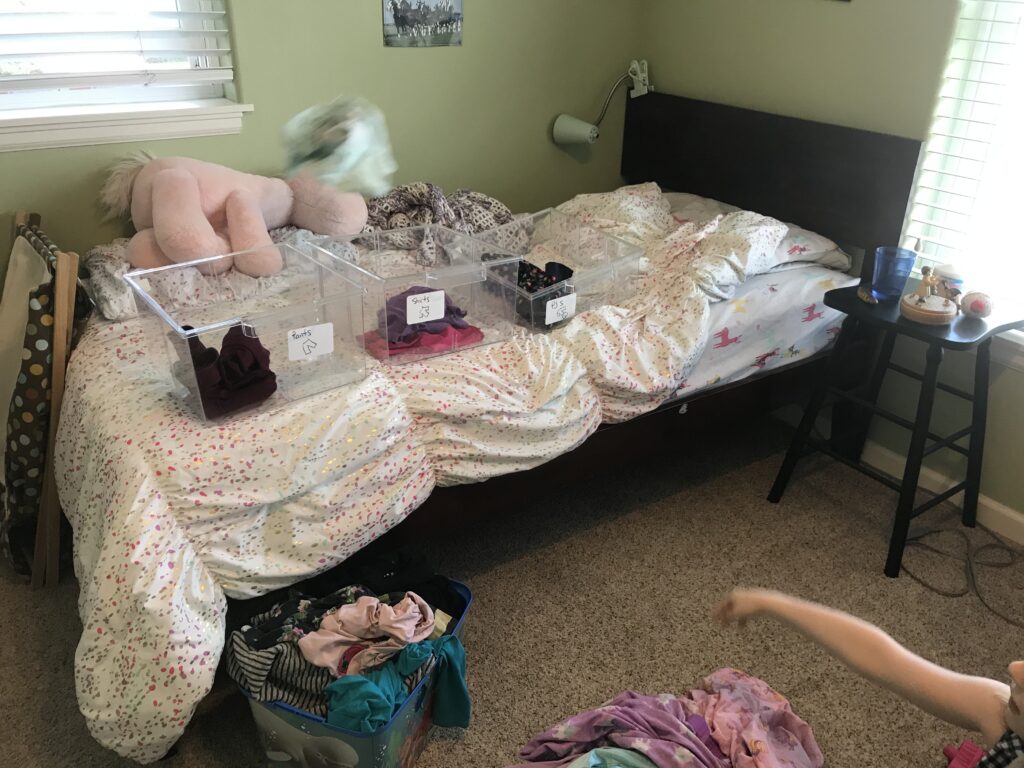
My kids don’t fold their clothes. The clothes are sorted by item and shoved in drawers. They know how to fold, but I’m not going to spend a bunch of time folding their clothes or nagging them to do it. We sort them, play a game of basketball as they toss their clothes into the drawers, and call it a day.
Ask for help and give the other person ownership over the task. They’re not helping you, you’re working as partners. Buy the cards from Fair Play and use them for a discussion about household work.
We aren’t going to solve this problem with a conversation, but we can start shifting it with a conversation.
Do you time block? Do you know what that is? Time blocking is assigning a specific time to a specific task. This could work in several ways.
Processing emails at specific times (30 minutes at lunch and the last 30 minutes of your workday).
Scheduling all the calls you need to make for work on Thursday morning.
Blocking time once a week for planning the next few weeks (so important to keep you on top of things!).
Mondays are for marketing, Tuesdays are for staff meetings and open office doors for any staff questions, and Wednesdays are for creative planning, etc.
Scheduling time each week for bigger projects that require focused deep work for several hours.
Do laundry or buy groceries on certain days.
Time blocking ensures you get the big stuff done. It’s scheduling the big rocks and letting all the sand fall around them.
Spend your days focusing on your priorities, not flinging from one task to another. You get ahead of the fires and last-minute urgent tasks.
And when you block the time on your calendar, you’ve made time for those priorities. Your brain can rest because it knows the important tasks are taken care of.
What happens if you’ve blocked your time but a crisis interrupts it? Good question.
If this happens, it helps to have a handle on your tasks and schedule over the next few days or even weeks. Then you know what time blocks to switch around. Take some time to reschedule a few things so you can deal with the interruptions. Do this only after deciding whether the interruption needs to be dealt with immediately or if it can wait.
Read more about where your time goes here. And if you want to talk about how to incorporate time blocking in your days, schedule a call with me.
Are you busy or productive? There is a difference!
What do clarity and productivity have to do with each other?
Are you clear on your life goals and values? Do the tasks on your to-do list support these goals? Or are you just doing things without really thinking about them?
It’s ok if you haven’t thought about it much. But let’s take a few minutes to do just that. If you’re only doing things on your list because they are there, without thinking about how the tasks fit in the larger plans of your life, then you are simply busy. Not productive.
And that’s no way to live.
Taking time to think about where you want to be in several years, or even six months ensures that what’s on your to-do list supports these plans.
It motivates you when you don’t want to do something on your list. It helps you clarify the next step.
Let’s Clarify
If you want to play tag with your kids or hike all summer, then taking a walk or exercising in the depths of winter is on your list. You might not want to do it today, but you know your future self will thank you.
If you are looking for a promotion at work or to grow your client base, then make sure the small steps you take today support that goal. It might mean a conversation with your supervisor or a business coach to understand those steps. It might mean stepping out of your comfort zone. Again, that clarity guides you.
That clarity guides you when you lack the motivation to do anything. Maybe you’re tired. The weather is crummy and you want to curl up on the couch and watch a movie. Maybe the weather is nice and you want to go play outside.
When you’ve done the work to clarify your values and where you are headed, you have clarity around today’s tasks. You know what needs to be done and you can take those next steps.
And when those tasks are small, you almost have no excuse to not tackle them!
If you want more information on how to start this work, sign up for a free coaching call! Or, sign up for my private podcast for more ideas!
Let’s take a look at some productivity myths. It might seem like while we are drowning in our tasks and commitments, we can’t take the time to fix things. We just stumble through, feeling like someday things will get better.
But they don’t. Because we’re not making any changes. We’re too overwhelmed. We don’t know where to start. We don’t feel that things are going to get better.
Productivity Myths
I can’t take a break or even get a good night’s sleep. I must keep working and crossing things off my to-do list.
Actually, at some point, you stop being productive because you’re so tired and exhausted.
Taking restorative breaks and even sleeping helps you get more done.
The world will not stop spinning if you take a few hours or possibly a day to take care of yourself.
And, when you rejoin the world, you’ll be more productive!
I didn’t cross everything off my list. I’m such a failure. Why can’t I get anything done?
First off, you are not a failure! My guess is you get more done each day than you give yourself credit for.
You likely have more on your list than you can actually accomplish on any given day. We only have so much time and so much energy.
Figuring out what tasks need to be done each day and letting the rest go is a big step toward changing your relationship with time.
I’d like to hear where you struggle with productivity! Connect with me on your favorite social media platform and let me know!
If you’re ready to change these myths in your life, start here.
I was recently talking to someone about being busy. She said she knows she’s busy when she’s been working 7 days straight for weeks on end. Not making time for anything fun.
And yes, that is busy. I also wonder if being busy includes those fun activities that we said yes to long ago but no longer find fun.
If you’re used to plowing through each day, hauling kids from one activity to another (or running to your own), crossing tasks off your list as fast as you can, falling into bed exhausted at the end of the day, then you might not even be aware of how you are spending your time.
We committed to something and continue to do it because we feel we should or we don’t know how to say no.
We do what’s on our task list because it’s there, not really thinking about why we are doing it and if it’s worth the time.
How do we break this cycle?
What if you tracked your time, every 30-60 minutes for one, maybe even two weeks? (Find resources on how to do that here.)
Then spend time evaluating where your time is really going.
When we track our time, we know where it’s going. We might think we’re spending a lot of time working, but we’re really not (or vice versa). Or that we’re rarely on social media, but in reality, the amount of time we spend mindlessly playing on the Internet surprises us. Or that all we do is laundry and dishes. But in reality, it’s less than 20 minutes a day on both.
Then, what if we took that information and started being more intentional with our time? Finding ways to stop doing the things that no longer serve us. Focusing on the tasks that are moving us forward in our lives, both professionally and personally. Wrapping up the projects that we’ve committed to but they linger because we’re not invested in them anymore. (and, wrapping up could include delegating or deleting, if that’s possible).
What does your time look like? Are you busy? Or are you spending your time intentionally?
If you want to talk about tracking your time and what to do with that information once you have it, schedule a 30-minute call with me!
Yes, I said it. I think busy is a four-letter word. And not a good one.
Are you constantly doing something? A task on your to-do list? A commitment or activity?
Is everything that you’re doing moving you forward personally or professionally? Or the required parts of living, like dishes and laundry?
Or are there things on there that you do but aren’t really necessary? You’re going through the motions, without thinking about what you’re doing? (It’s ok, be honest with yourself here).
Sometimes, I think our society treats being busy as a badge of honor.
We’re a country that doesn’t guarantee time off. Most companies who do offer vacation time only offer about two weeks. And those of us who have vacation rarely take that time. And if we do, we’re checking emails and taking calls.
We never really rest.
Outside of work, we have ourselves and our kids signed up for every activity under the sun. Every minute is a scheduled play date, sports, or music activity. Weekends are full of birthday parties, more play dates, and more sports.
We can’t let ourselves or our kids ever utter the sentence I’m bored. (Side note here, I’ve read it isn’t actually that they’re bored, but that they want connection with you. And giving them connection, and sitting with them in their boredom for a few minutes, moves them out of it).
We never stop that constantly running list in our heads. When we’re working, we’re thinking about the house tasks and if we’ve spent enough time with our kids. When we’re with our kids, we’re thinking of all the other tasks we’re not doing.
So we’re never really present in our lives. This is part of our overwhelm. This constantly feeling like there’s something else we need to be doing.
And we complain about it, but in a way that makes it seem like there’s really nothing we can do about it. (Or that we enjoy it, maybe, we’re not sure. We’re too tired to really figure it out).
So what do we do?
So, what happens if we say no to a few of those birthday party invitations? To all the activities? Picking one or two for each family member each season?
What if we make time for leisure? For rest?
Those to-do lists are always going to be there. There will always be something that needs to be done.
If you have ways to manage your tasks (something I talk often about here and in my virtual community, Stride Together) you know that your big stuff is taken care of. It’s documented. It’s scheduled. There’s time. So you can focus on the work task or spending time with the kids.
The pandemic is still complicating things. It might still be a year for social distancing and smaller parties. Or more of staying at home and visiting friends and family on Zoom.
Regardless of how you spend the holidays, here are a few ideas for thriving, not surviving.
Simplify
Maybe you’re one to go overboard for the holidays. Everyone gets gifts. You mail cards to everyone you know. And your family is wearing matching PJ’s in the photo that’s on the card you send.
If you love doing this, please keep doing it. If you do it because you feel obligated, take a step breath, and keep reading.
Make a list of everything you do during the holidays. Look at the list. Examine it.
Do these tasks make you happy? Or are you doing them because you feel you need to? Are there a few that you can skip?
Pick the few items that make you happy. Cross the rest off. No one will notice!
Ask
Ask each family member to pick one activity they enjoy and want to do during the holidays.
Schedule it.
Stick with the activities that your family enjoys. Skip the rest! You will all be happier.
You do not have to say yes to every event that comes your way. If you love attending all the parties and it fills you up, then go!
But realize that might not be true for everyone in your family. Or you. And that’s ok.
Say yes to the events that you and your family get the most out of.
When you’re overbooked, you don’t enjoy the holidays. It feels like one thing after another and before you know it, it’s January and you’re left wondering what happened.
Being intentional about the events and activities you take on helps you feel present at each of them. Sinking into the fun of the moment.
Simplify Some More
Are you hosting a meal? What can you do to make it easy? In our family, the person hosting makes the main dish and everyone else brings a side dish. Everyone signs up for something so we don’t end up with 6 side dishes of mashed potatoes. And it takes the pressure off the host to not be in charge of everything.
Maybe it’s never been done this way in your family. Maybe it’s always been on you to make the holidays happen. That doesn’t mean you can’t request a change. At least start the conversation. It could be as simple as everyone else bringing appetizers or desserts.
After The Holidays, Evaluate
In January, spend some time thinking about what worked and what didn’t work in December. What did your family enjoy? What do you wish you had skipped? Take notes and put them somewhere you will find next November.
Try a few of these ideas this year. The key is to only do the things that make you happy. Don’t wear yourself out doing everything! Doing a few things allows you to enjoy those activities and tasks and get the most out of them.
If you want more ideas on how to simplify your life, schedule a Get On Track call with me and tell me you want to talk about the holidays!
Are lists helpful? Yes! We recently bought a new house and moved and I made so many lists to make the process easier.
We knew we wanted to move early in the year before we’d even applied for mortgages or found a realtor.
We started by cleaning out closets. One shelf at a time. We donated so much stuff!
Then we moved on to finding a realtor and making a list of what we wanted in a house. Where we wanted to live. The non-negotiables when it came to location or the house layout.
And there were so many lists. Address changes to make. Documents to gather to apply for our mortgage. Items to figure out the best place to donate.
The lists helped us know the next steps to take. I could sit down and spend 10 minutes changing addresses. I knew the order we wanted to pack the house so I could work on 1-2 boxes each day.
So are lists helpful?
Knowing the next step of any project helps it be less overwhelming.
When you get a new project or are stuck on a current one, take time to identify all the steps. As small as possible.
Then do the first one. And the next one. Slowly but surely, you will get there.
Many articles from the past year would make you believe that you are not doing enough. With so many people being home during the pandemic you suddenly had time to clean out your closets, finish all those personal projects that have been lingering on your to-do list, and learn a new language. And if you didn’t suddenly find yourself motivated to tackle all of these things, well, that’s on you. It’s not that you haven’t had time, you’re just lazy and lack discipline.
Huh. Really?
Because you weren’t also taking care of kids while juggling full-time work or just trying to get through the day because it seems as though the world is coming down around us.
I have shared how I feel this pandemic has wiped the slate clean for many of us. How this is a great time to think about what we want our lives to look like as we move forward. And not to rush back to the craziness of life BC (before Covid).
It’s ok if that hasn’t happened. If you’re aware of it but not ready to process it or figure it out.
We are going to be processing the trauma of this pandemic for years to come. Disruption is everywhere. And the changes keep coming.
The pandemic is still here. And as long as people are still refusing to get vaccinated and wear masks, it’s not going anywhere. Until more of the global population has access to vaccines, it’s not going anywhere.
And we are going to struggle to move forward until that changes.
There are many articles out there related to your productivity and the pandemic. Getting motivated to work during the stress of a pandemic. (here are my thoughts on that) That with no commute, you have so much more time on your hands! You should be working more!
Because our society will have you believe that the more you get done, the more you produce, and the more you cross off your to-do list, the better! Because our value is all about productivity.
No. It’s not.
You are not your productivity.
If at the end of the day, your kids are loved and fed, you are doing enough.
Surviving a pandemic is enough.
One of the things we talk about in my virtual community, Stride Together, is that knowing what’s important to you helps you prioritize your tasks. You focus on the things moving you, your family, and your business/job forward. Productivity is not about getting it all done every day.
If you’re struggling with this, let’s talk. I want to help you clarify these things for you. Even if it’s to set you up for success as we move out of the fog of this pandemic.
It’s Sunday night. I’m wondering what the heck happened to my weekend. What exactly did we do? I think I crossed a bunch of tasks off my list. The laundry is washed and dried, not necessarily put away. I’m tired. And I’m starting to dread Monday.
I’m looking at my calendar and tasks for the week. The week looks full. Maybe even overflowing. How am I going to get through this week? I’m tired just thinking about this week. I already wish it was Friday!
Sound familiar?
Life doesn’t have to be this way! Becausewe don’t have to continue to be so busy that we’re exhausted simply thinking about our week.
We don’t need to dread Monday!
What if you designed a life you don’t need to escape from?
If you knew your daily priorities and that you were able to complete them?
Maybe you even have time for activities you love? For that ever-elusive ‘me-time’? (I promise, it is possible!)
I want you to do something for me. Spend some time thinking about what you want your life to look like in the (near) future. If you didn’t have the dreaded Sunday scaries.
Maybe it’s planning something fun that you look forward to for Monday or Tuesday nights. Nothing complicated. It could be a regular phone call with a friend. A virtual dance class or yoga class.
Try saying no to any new activities that come your way, while you figure out what activities you and your family want to take on next. Not signing up for soccer, dance, and piano lessons for each kid. Pick one activity for each family member (which can, honestly, still be a lot to manage each week).
I know that might feel like a lot right now. I’m just asking you to think about it.
I think this pandemic has changed so much for all of us. In big and little ways. We’re physically and emotionally exhausted and drained. Our routines are a mess. Our ability to make decisions is fried. We never know if the decisions we’re making are right.
Maybe you’ve spent the past year and a half barely surviving each day. It was all you could do to get your work done and take care of your kids. You looked at Facebook and felt like everyone else was taking on a new hobby or finding their passion (whatever that means!).
And you know what? That’s ok.
Simply getting through each day is sometimes enough. Sometimes that’s all we can do.
Let’s stop talking about getting back to normal. I don’t want to go back to normal. I’m not even sure what that is. I don’t want to go back to who I was in 2019 or even February 2020. I’m not the same person.
For me, this pandemic has wiped my slate clean. It’s clarified so much for me. What’s important to me. Who is important to me. What I want my life to look like in the future.
Honestly, rebuilding from scratch sounds less exhausting than going back to the way things were. Where you ran from one activity to another without really thinking about it. Attending every birthday party, sports activity, and event you were invited to. Using retail therapy as a way to feel better about how crazy things were. And talking about being busy like it was a badge of honor.
How about creating your life with intention. Building a life that you don’t need to escape from. That doesn’t require weekly massages or bubble baths to relax or feel slightly better about things (next week’s topic).
What steps can you start on now? They can be the smallest steps necessary! Take that first step and see where it leads you!
A few weeks ago, we were all picking up the house so that we could more thoroughly clean it. My 5-year-old daughter refused to participate. She’s 5. She’s stubborn and she’s not going to do anything she doesn’t want to do.
So I let it go and we all moved on.
A little while later, I hear her saying she’s cleaning up to help me. Because mom needs it.
Now, I understand that often our kids do stuff around the house to help mom. Mom’s the one who manages the chores and house cleaning (more on why this is a problem at a later date.)
But I didn’t like the way she said this. I didn’t like that she was only doing it because Mom was mad.
My kids need to learn how to pick up after themselves. Participating in a team (family) is a life skill. Helping is a life skill. So is cleaning up after yourself. Our kids need to know how to do this stuff on their own.
We need to all participate in keeping the house functioning.
Here are some ideas to get everyone involved:
Make it fun. Don’t tell your kid to go clean their room. Their brains will shut down and it won’t happen.
Turn it into a game. We play basketball with my kids’ laundry. You can do the same with any toys that go into a bin. (side note, don’t use bins with lids.
Have kids race against you (never against each other. Siblings are already competitive enough). See if they can put something away faster than you.
Make it easy to put things away. (Lids add one more step).
Do something fun together as a family once you’re done.
If your kids are older, these same guidelines apply. Get them to participate. Ask them how they want to participate (and skipping out is not an option).
Keep it small. We clean half the house each weekend so it’s not overwhelming. We pick up most of the mess each day so it doesn’t get overwhelming.
How cluttered your house gets is up to you and those who live there. What is your level of acceptance of mess? I don’t have the energy for a spotless house every day. I do like a weekly reset. Figure out what works for your family.
Do you have days where you stare at your to-do list, unsure where to start? There are so many things on the list. You don’t want to do any of them but you know you need to complete at least some of them if you want to keep your job or the roof over your family.
But really, you want to crawl back in bed with chocolate and a book.
I get it. At this point in the pandemic, I need almost daily pep talks to get out of bed. Every day feels the same. I usually like snowy weather, but this year, I’m over it. I’m ready for sun and warm days. (It’s currently April and snowing here in Denver).
And if you could see the toys spread around the house. I’m worn out from getting the kids to pick up every day. Sometimes, I wonder why I bother asking them to clean up (and some days I don’t). They’re just going to make a mess again tomorrow!
And everyone needs to eat. All the time apparently, by the number of dirty dishes in our kitchen!
So why am I sharing this?
Because I get it. I get the daily struggle of finding the motivation to get those work tasks done. Of finding the energy to have another pillow fight with the kids. Another game of tag. Figuring out what’s for dinner. And when did the kids last have a bath?
This past year has been tough. This pandemic shifted so many things for so many people.
And I think some good will come out of it. I think people have realized what’s important and who is important, in their lives. Families have enjoyed having a slower pace of life. And I hope that continues as we move into this next phase of life.
We’re moving towards another chapter. What do we want that to look like? (Read more on this here.)
And how do we get motivated today? Here are a few simple ideas to get you started. We’ll keep talking about this over the next few weeks.
Move your body. Have a dance party. Create a list of music that energizes you. Exercise. Take a walk. Play tag with the kids. Whatever it is, get your body moving.
Know your tasks. We’ll talk about values a bit more next time. But when you know what truly needs to happen today, you can focus on those tasks. What next steps need to happen today? Everything else can wait.
Know the next step. Break your tasks down to the smallest possible next step. Then take it.
Manage interruptions. If you’re struggling to focus, minimize interruptions. Find more ideas here.
Pick one idea. Try it. And, if you struggle through today, know that tomorrow is another chance.
Do you feel like you’ll never get caught up? Here are two more productivity myths. How do they fit into your life?
I’ll never get caught up. Tasks just keep coming at me and I spend all day putting out fires!
What does caught up even mean? You’re never going to get to the end of that to-do list and that’s ok!
What if you knew that the tasks you worked on each day were the ones moving you forward in life? And over time, as you get better at planning your days, you get ahead of those fires?
It is possible to feel on top of your to-do list!
I have to do it all myself. If someone else does it, it won’t be done right.
What happens if it’s done differently or not up to your standards? And how exhausted are you trying to do it all and never letting anyone help?
Hold a conversation about what a completed task looks like. It’s one less thing for you to worry about!
Yes, it does take a village. Your family or team should be helping – let them!
Where do you struggle with your productivity? And what do you think of these productivity myths? Follow me on Instagram and DM me your struggles! Or, sign up for my private podcast to learn more!
Do you make time for yourself? Do you keep appointments you make for yourself? What about making time to do those things that aren’t high priorities but are things you’d like to do someday?
The things you know would make you happy or contribute to society in some way, but you’re too busy cleaning the house, completing work tasks, and entertaining the kids to get to?
What if you made appointments with yourself that you kept as strictly as you would a client meeting, doctor’s appointment, or coffee with a friend?
I’ve had several people ask me how to make time for things they’d like to do but aren’t high priorities. Taking digital classes (personal or professional), volunteering, and doing things outside of chores and work lists.
I suggest spending just 30 minutes taking a class (maybe even 15, if that feels better). It’s not much, but over time you will make progress. Treat the time you schedule for yourself with as much respect as you would a client appointment or coffee with a friend.
Another suggestion includes letting go of the need to keep up with all the household tasks all the time. I’m not saying let your house grow mold. But what if you spend one afternoon a month volunteering, taking a pottery class, or hiking with your family or a friend? Your house isn’t going to fall apart during that time.
And at the end of your life, you’re not going to remember having a spotless, well-maintained home. Or how many things you crossed off your task list. You’re going to remember the things you did with your family and friends. The experiences you created.
I’m not saying you should skip out on your priorities. But we also need to make time for ourselves and time for fun. And it’s ok to schedule it. You should schedule it, otherwise, it’s not going to happen.
And, when you take breaks from your task list, you just might find yourself more productive when you come back to it. You might find that doing something else helps you solve some big client problem or gives you an idea for something at work.
Want to figure out how to put this into practice? Schedule a call with me! We’ll talk about the first steps in making this happen.
Let’s talk about technology. It can be a wonderful thing. Caller ID. Text messaging. The ability to see the faces of friends and loved ones who live far away. Any funny meme that helps you get through the day.
But technology is also full of time sucks and interruptions. Your phone constantly dinging with message alerts. Your email notifications popping up while you are working. Someone commenting on a Facebook or Instagram post.
All of this distracts us from our priorities. We can’t focus on deep work when we’re constantly being interrupted. Or, we think the interruption is a priority so we stop what we’re doing to answer the phone, read the emails, respond to the text messages.
What if you took back control of your time and focus? What if you turned off those notifications, closed the email programs, and didn’t have your phone constantly in your hand or pocket?
I’m going to guess that the world will continue on just fine. It won’t stop spinning. And, you are likely to be more productive and not feel pulled in so many directions!
Here are some more ideas to stop letting tech control you!
Respond to those messages and calls on your time.
Have auto-responders for your email stating you received their email and will respond within 24 business hours (or whatever your company requires for responses).
Have specific times of the day that you sit at your computer and process emails. Block the time on your calendar. Spend that time only processing your emails.
Turn off all notifications to email, text, etc.
Delete apps from your phone to minimize distractions.
Turn your phone on silent or leave it in another room when you are doing some deep work.
Put an analog clock somewhere in your office so you’re not looking at your phone to check the time. Plus, analog clocks give you a better understanding of the passing of time!
What are you going to do this week to stop letting tech control you?
Do you spend your days multitasking? Do you end your days feeling frazzled, like you got nothing done and wondering where your time went?
Are you constantly checking your email while on phone calls? Or jumping back and forth between tasks on your computer?
Studies have shown that effectiveness drops by 69% for women when we multitask! That’s huge! I’ve also heard that it can take 90 seconds to get back to a task for each email notification that distracts us (turn off your notifications!) Think about how many emails you get in a day and how much time is wasted with these distractions!
Imagine how much more you could get done in a day if you focused on one task at a time?! Our brains can’t work efficiently when focusing on more than one task at a time.
Yes, some things can be done simultaneously. Running a load of laundry while you’re cleaning the kitchen. Exercising while listening to your favorite podcast or talking to a friend. Stirring something on the stove while talking on the phone. Batch tasks that require little focus (or no focus, like laundry).
But if you’re working on a big work project, only focus on the tasks associated with that project. Processing emails counts as needing focus. (and please, no talking or texting while driving. Driving counts as one of those high-functioning tasks that you should focus on while doing it).
We’re so used to multitasking, what can we do about it? Here are some ways to break the habit:
Be aware of when you start to multitask. Catch yourself and get yourself to focus on one task.
Set a timer for 15 minutes and focus on one task. You can stop when the timer goes off, or you can reset it for another 15 minutes.
Focus on one task at a time. If another task pops into your brain while you’re working on something, quickly write it down on a nearby piece of paper and get back to the task.
Know your top 3-5 tasks for the day and have a general plan.
Let me know how you feel about multitasking. Do you think you’re good at it or do you feel that it pulls you in too many directions?
If you’re ready to stop multitasking and start checking tasks off your to-do list, schedule a call with me.
It feels hard to plan much of anything in the middle of a pandemic.
If your kids are in school, you never know when you’re going to have them home for the next 2 weeks due to possible exposure to COVID-19.
It’s hard to plan for much of anything beyond the next few weeks because we just don’t know what life will look like this summer or fall.
This feels more complicated and disruptive than a snow day or a sick day. Maybe it feels heavier. Maybe the endless, monotonous days are getting to you! (They’re definitely getting to my family).
So how do you plan anything or pay attention to how you’re spending your time?
One way we can have more control over our time is to identify our daily and weekly priorities. When you know what you need to do each day, it’s a little easier to focus. If you’ve planned out your week (with room for things to shift) then you can handle last-minute surprises.
These last-minute surprises could include a snow day or a sick kid or your kids moving from in-person learning to remote learning due to COVID-19 exposure. They could also be a last-minute project your boss throws at you.
It’s easier to focus when you know your top priorities for each day. It’s easier to shift things around when you know your priorities for the week.
This does not mean planning every minute with tasks. This means planning your top 3-5 priorities and leaving room for things we didn’t plan for.
Take some time each day and start planning your top 3-5 priorities for the next day!
If you want help with identifying your top priorities for each day, schedule a call with me!
We’re spending this month talking about interruptions. Last week we looked at how this pandemic has been one big life interruption (and 2021 isn’t shaping up to be all that different!) and how now is a great time to really examine the life we are creating. What activities, people, habits, and things do we want in our lives? What is important to us? Maybe you’re tired of the interruptions.
This week we’re going to look at a practical idea for dealing with interruptions both in your house and at work.
Think about scheduling office hours.
This minimizes interruptions and can be used in the office or when working at home. You get to focus on deep work, the stuff you never get to because you’re always being interrupted.
Let people know that during certain hours, you do not want to be interrupted unless it’s an emergency. If someone does interrupt when it’s not office hours, ask if they can come back. If not, decide if it’s worth the interruption. And make a note of what you were working on so you can get back to it when it’s time.
Find a way to mark your office door, calendar, or wherever you work so your family or colleagues know you’re working.
Then, during certain hours, your door is open and people can ask questions and talk to you. Focus on work that can be easily interrupted, such as processing emails, work that requires less thinking, etc.
Yes, it might take some time for your family to understand and learn to respect these boundaries. Especially if they’re used to interrupting you and having you respond immediately.
But hold to these boundaries. Everyone will be happier in the long run, mostly because you’ll be less annoyed!
How much time do you waste daily? Are you aware of how much you procrastinate or put off a task because you don’t want to do it or are not clear on the next steps? A 2015 time/work survey showed that 70% of people waste time because they feel stressed or uninspired. And 50% spend too much time procrastinating. Does this sound familiar?
I’ve noticed my kids fight to do something they don’t want to do. They spend more time arguing with me or coming up with excuses to get out of doing something, like taking a bath or picking up a few toys than if they’d just do the task. In most cases, watching TV is waiting for them at the other end of this task. And if they’d just do it, they’d have more TV time. They’ll be running around the house. I’ll ask them to pick up a few toys. Suddenly they’re lying on the floor, too tired to help!
Think of the emotional and mental drain of this!
Stop Wasting Time!
So how do you work through this? Here are a few ideas.
Identify the next steps. Break any overwhelming projects down into small steps. Then you take the next step, then the next, until you complete the project
Set mini-deadlines. Take the small steps you identified and set deadlines for each one. Hold yourself to those deadlines. Make yourself accountable to someone else or set up payment to a non-profit you can’t stand. If you don’t make the deadline, your payment goes!
Set a timer. Work for 30 minutes or any predetermined amount of time. When the timer goes off, you can stop for the day. Or, you can keep working. Sometimes getting started is the hardest part.
Are You Avoiding Something? Figure Out Why.
Maybe you’re avoiding a project or task for a specific reason. It’s tedious. Sometimes, you have to power through something to get to the good stuff on the other side. Maybe it’s challenging (break it down into doable steps). Maybe it’s something you don’t like doing for your own business but you’re not at the level yet where you can outsource it.
Spend some time figuring out why you’re avoiding something and you can likely figure out a solution. Also, think about what you could be doing with your time if you’d complete those tasks. Your future self will thank you!
Are you feeling uprooted? Like this pandemic turned everything in your life upside down? Me too. I’ve lost track of how many weeks we’ve been home. And although our city and state have lessened restrictions, we’re still staying home as much as we can.
I can sense that people are aching to get back to normal. But I don’t think things are ever going back to the way they were before this pandemic hit. And I’m ok with that. Why? Because now is the time to rethink everything. It’s a blank slate. A time to start fresh.
A time to plant new seeds.
Where do we start?
We have some work to do first. We need to grieve the life that once was. So many people have lost loved ones, jobs, livelihoods, innocence, a sense of security. Maybe you’ll come out of this mostly unscathed, but I bet it’s touched you somewhere in your life. Spend some time grieving.
I’m grieving my youngest having her preschool graduation without her friends. Surrounded by her teachers, her sister, and her parents, it was only her, wearing her cap and gown. During a timed ceremony so we wouldn’t interact with too many others. I can only imagine how parents and kids who didn’t get their high school or college graduation ceremony feel. These rituals bring such closure.
I’m grieving the last few months of spending every Tuesday with my daughter before she heads off to kindergarten. I’ve spent every Tuesday of the last 7 years with one or both of my girls. Although I was tired of figuring out how to entertain a small child every week, Mommy and Ellie days were special.
What do you need to grieve? Spend some time sitting with it and working through it. Mourn the memories that never were.
Once we’ve grieved, we can begin planting new seeds.
Next comes the part I’m most excited about. There is such an opportunity here. It’s time for a shift in thinking. Instead of longing to go back to the way things were, let’s reinvent. Let’s look at our schedules and priorities and figure out what really matters. How do we want to be spending our time?
I want to see our society have some big, deep discussions about so many things. Work, education, the division of housework and parenting. Generally, the way our society functions.
I’m not looking to have a big political discussion here. But we need to start with learning how to have deeper discussions. Instead of constantly complaining about how things aren’t working or dismissing someone who thinks differently, we need to listen and work to understand each other. Maybe once people start feeling heard, we can come together to fix things. People won’t dig in their heels and refuse to hear someone else because they won’t feel attacked. One place I’ve started is by reading Crucial Conversations.
Let’s start with work.
I do understand that not every job is flexible. You have to show up for a shift at the grocery store, hospital, just about every job in the service industry. Maybe there are ways to put more flexibility into these jobs. I’m talking about knowledge workers here. There are plenty of jobs focused solely on how much time you spend at your desk in the office. It doesn’t matter how much you do while you’re there. But you better be in your seat.
My husband was let go from a job many years ago because he wasn’t in the office by 8:30am every day. He was working close to 70 hours a week, but some of that was at home. He had young kids and wanted to be around to see them. This company couldn’t see that the amount of work or the quality of work is what mattered. It didn’t take the time to notice anything but when he was at his desk.
The shift in thinking here comes from defining success for these positions. Then, setting expectations and a deadline, and letting employees make it happen. I bet there will be a lot more creativity that comes from that freedom. Plant some new seeds.
Also, take a look at how many meetings are necessary and how people are communicating. I’m guessing some things can change there too. Does every meeting end with defined next steps? Or are they just a waste of time? Watch this quick 1-minute video about one thing you can do for more productive meetings.
The workload for women.
And what about the workload, both at work and at home, for women? Why is it that women are asked how they balance working and parenting but we never ask the dads? Why is it women are expected to do it all but we don’t expect it from the dads? Don’t tell me it’s because women are better at multitasking (I’ll get into that some other time). Think about what we’re teaching our kids – that it’s ok for the men not to help and the women need to do it all because no one else is capable.
There needs to be a shift in thinking here. A shift that we’re all in this together. That we all succeed or fail together. We need to stop with this thinking that we need to do it all by ourselves. Plant some new seeds.
Let’s rethink how we spend our time.
Have you created new routines during this pandemic? Maybe you’re walking the dog every morning or taking family walks before dinner. My husband and I are taking one night a week to play cards after the kids are in bed. I’ve wanted to cancel my gym membership and have more flexibility in when I work out but never made it happen. I’m exercising more now that I’ve made space for it in my living room.
Are you finding yourself enjoying more leisurely family dinners? Taking the time to watch your kids play in the backyard? Is it nice to not be rushing from one activity to another? Or maybe you’ve been so overwhelmed by work and remote learning and having the kids home that you’re exhausted.
I hope there’s been more quality family time. I hope that as activities begin to resume you don’t go rushing out signing up for everything. I hope you find some peace in not rushing from one place to the next. In having family dinners (or breakfasts!) regularly. Before you start filling up your schedule, figure out how you truly want to be spending your time. Commit your time carefully. Plant these new seeds meaningfully.
What about our stuff?
You’ve likely spent the last few months surrounded by your stuff. Is it driving you crazy? Are you finding it useful? Have you spent time sorting through and organizing it? We’ve rearranged toys to make them easier for our kids to use. We have a table just for arts and crafts now. We have a charging station for tablets and computers. We have learned more about how we use our space. That we really don’t need a big house and that when every toy is on the floor, it feels like a lot.
When we have less stuff, it’s easier to maintain an organized home. And it’s easier to use things because it’s not so overwhelming and we can find what we’re looking for. If our house is too cluttered, we can’t find what we need.
So take a look around your space, figure out what you love and need, and let the rest go. How do you want to feel when you are in your space? Comfortable? Content? Happy? Work towards getting your space to create that. Plant some new seeds with your space.
And related to our stuff, what about our spending?
Since you’ve been home, have you saved money because you’re not wandering through stores buying things you don’t need? Or are you just overbuying on Amazon? I’ve loved not spending money buying things we don’t need. It’s been nice to think about repurposing something we have in our house to fulfill a need. Or knowing that we don’t need more stuff in our lives. Plant some new seeds around spending. It relates to clutter as well. Retail therapy leads to short-term relief. The stuff you buy takes up space in your house. It needs to be maintained or it just creates clutter. Take some time to figure out what’s behind that and find new ways to fill your cup. Plant some new seeds.
Time to plant some new seeds.
We need a shift in thinking. Let’s do things differently. Let’s move forward into something better. Let’s plant some new seeds.
If you’re ready to plant some new seeds in your life, let’s talk!